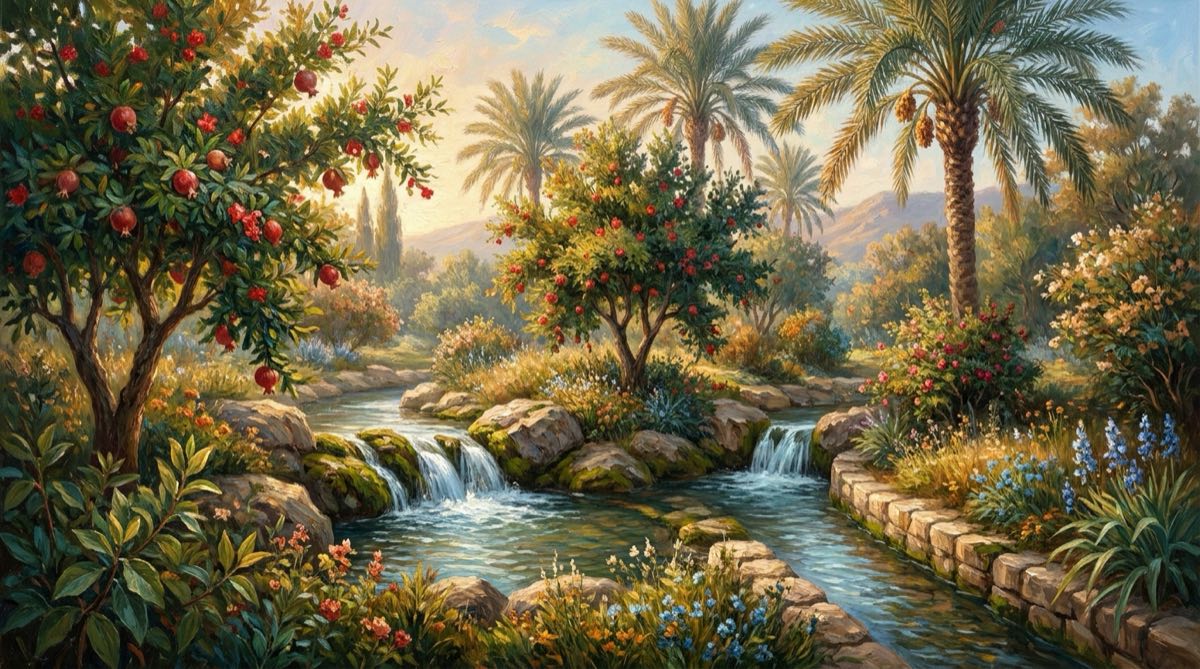

Near the end of Surah Al-Waqiah, Allah describes a room we will all be in one day. Someone we love is dying. Their breath reaches their throat. We are sitting beside them, holding their hand, helpless. And then:
وَنَحْنُ أَقْرَبُ إِلَيْهِ مِنكُمْ وَلَـٰكِن لَّا تُبْصِرُونَ
“And We are nearer to such a person than you, but you cannot see.”
Al-Waqiah 56:85Al-Waqiah, “The Inevitable Event”, is a surah about the moment that comes to everyone: the Day of Judgment, and before it the moment of death. It divides all of humanity into three groups, describes each one's end, and in between asks us to look at the seeds we plant, the water we drink and the fire we light, and ask who really gives them to us.
It is 96 short ayahs over four pages, and many Muslims love to recite it at night. This guide gives you its structure, a 24-day plan, an honest note about its most-quoted virtue, and the spots where memorizers slip.
Al-Waqiah at a glance
Surah Al-Waqiah in numbers
The three groups
The surah's whole structure grows out of ayah 7: “you will all be divided into three groups.”
Three groups, three ends
The foremost (as-sābiqūn)
Those who raced ahead in faith: brought nearest to Allah, in gardens of bliss. Ayahs 10–26.The people of the right
The righteous: among thornless lote trees, extended shade and flowing water. Ayahs 27–40.The people of the left
Those who denied: scorching wind and boiling water. Ayahs 41–56.The surah in six passages
| Ayahs | Theme | Memory hook |
|---|---|---|
| 1–12 | When the Event comes, the earth shakes and the mountains crumble to dust; people are divided into three groups. | The Event, then three groups. |
| 13–40 | The foremost (13–26) and the people of the right (27–40) in Paradise. | Near ones first, then the right. |
| 41–56 | The people of the left, and their denial of the resurrection. | The left, and their excuse. |
| 57–74 | “Have you considered…?” Four signs: the creation of man, the seed you sow, the water you drink, the fire you kindle. | Man, seed, water, fire. |
| 75–82 | An oath by the positions of the stars: this is a noble Quran, in a well-preserved Record. | Stars, then the Quran. |
| 83–96 | The moment of death, and the three groups once more; “So glorify the Name of your Lord, the Greatest.” | The throat, the three, the tasbih. |
The four “Have you considered?”
The middle of the surah is easy to mix up, because four passages begin almost the same way. Learn them by the thing each one points to:
- Yourself (57–62): “It is We Who created you.”
- The seed (63–67): “Have you considered what you sow?”
- The water (68–70): “Have you considered the water you drink?”
- The fire (71–74): “Have you considered the fire you kindle?”
Man, seed, water, fire: the things that keep us alive, each one asked about in turn.
A 24-day plan
Al-Waqiah in 24 days, about 4 ayahs a day
- Days 1–3Ayahs 1–12: the Event and the three groups.
- Days 4–10Ayahs 13–40: the foremost and the people of the right.
- Days 11–14Ayahs 41–56: the people of the left.
- Days 15–19Ayahs 57–74: man, seed, water, fire.
- Days 20–23Ayahs 75–96: the noble Quran, the moment of death, the tasbih.
- Day 24Recite the whole surah twice; check it against the mushaf.
An honest note on its virtue. A narration says that whoever recites Al-Waqiah every night will never be afflicted by poverty. Hadith scholars, including Imam Ahmad and Abu Hatim, judged it weak. Recite Al-Waqiah because it is the Quran, because it reminds you of the moment that matters most, and because every letter is rewarded, not because of a promise that cannot be relied on.
The full Arabic text, transliteration and translation are on our Surah Al-Waqiah page. It pairs naturally with Surah Ar-Rahman, which comes just before it in the mushaf.

Four ayahs a day: listen, count your repetitions and recite from memory while the app marks any word you missed.
Sources
- Quran 56:7, 56:85, translation: Dr. Mustafa Khattab, The Clear Quran.
- The narration about poverty (Ibn al-Sunni, al-Bayhaqi) is graded weak by Ahmad, Abu Hatim and others.