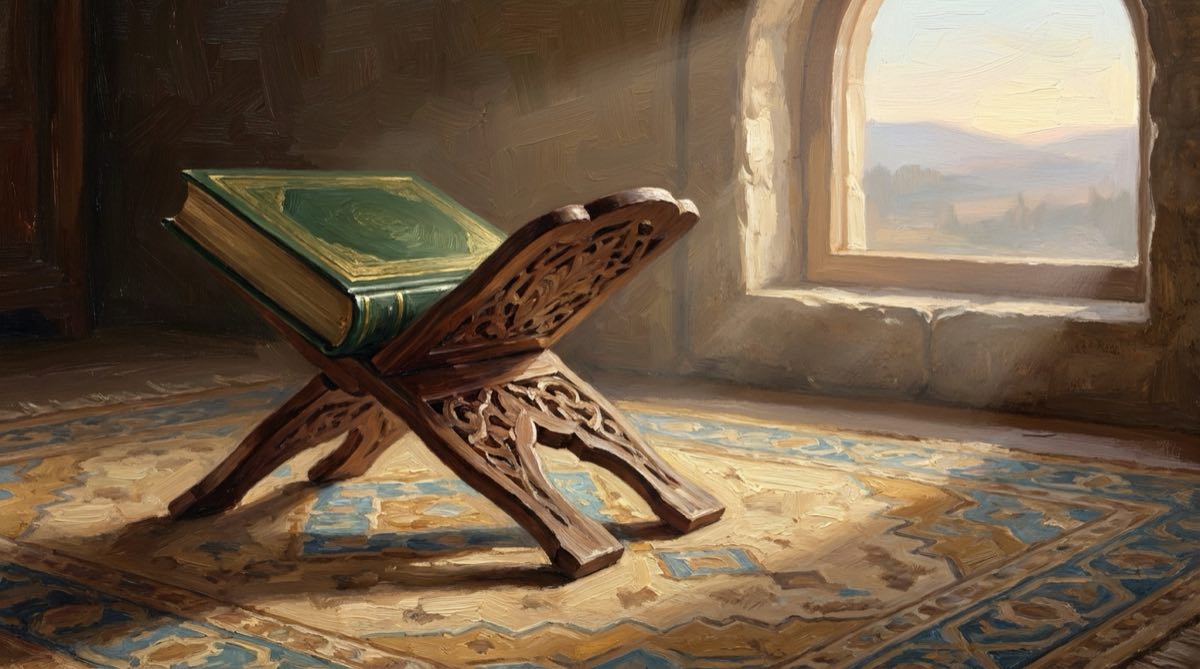

Before dawn in the Mauritanian desert, a boy rinses his wooden board in a bowl of water, watching yesterday's ayahs dissolve into grey ink. He has repeated them so many times they no longer need the board. At the same hour, in Istanbul, a student opens his mushaf not at the first page but at the last page of the fifteenth juz. In Lahore, a child rocks gently back and forth over a 15-line mushaf, waiting for his turn to recite to the ustadh. In a village in Egypt, a sheikh's voice rises and twenty small voices echo it back.
Different countries, different scripts, different tools. The same Quran, letter for letter.
In every Muslim community there are huffaz: people who carry the entire Quran in memory, word for word. Over fourteen centuries, different regions developed their own ways of getting there, shaped by their teachers, their scripts, their mushaf layouts and even their materials. We looked at how huffaz in eight traditions actually memorize: what they do each day, how they revise, and what each method is best at. Where our sources disagree or are thin, we say so.
What every method has in common
Before the differences, the common ground. Every serious hifz tradition rests on the same four pillars, and they all go back to how the Quran was first transmitted:
The four pillars shared by every tradition
Revision in particular has prophetic roots. The Prophet ﷺ reviewed the Quran with Jibril once every year, and twice in the year he passed away (Sahih al-Bukhari 4998; see also 4997). Every method below is, at heart, a different answer to the question of how to keep that review going.
1. The Companions: ten ayahs, then action
The earliest description of a hifz method comes from the generation taught by the Companions. Abu Abdur-Rahman as-Sulami, who taught the Quran in Kufa for decades, reported:
“Those who used to teach us the Quran from the Companions of the Prophet ﷺ told us that they would learn ten ayahs from the Messenger of Allah ﷺ, and they would not move on to the next ten until they had learned the knowledge and the action in them. They said: so we learned knowledge and action together.”
Musnad Ahmad 23482 (graded hasan by al-Arna'ut; some scholars note a weakness in one narrator)The method: small portions of about ten ayahs, learned directly from a teacher, together with their meaning and what they ask of you, before moving on. What it is best at: depth. It is slow by modern standards, but nothing is memorized as mere sound. Many teachers today recommend borrowing its core idea, reading the meaning of each portion before memorizing it, whatever method you follow.
2. Talaqqi: face to face, with a chain back to the Prophet ﷺ
The Quran was received orally, and in the classical tradition it is still passed on that way. Talaqqi (receiving) and mushafahah (mouth to mouth) describe a student sitting before a teacher: the teacher recites, the student repeats, and then the student recites while the teacher listens and corrects.
When a student recites the entire Quran to a qualified teacher without error, the teacher may grant an ijazah: a certificate that names the chain of teachers (sanad) linking that student, teacher by teacher, back to the Prophet ﷺ. Ijazahs are granted for a specific reading, such as Hafs 'an 'Asim or Warsh 'an Nafi'.
How a sanad is built
- The Prophet ﷺReceived the Quran from Jibril and taught it to the Companions.
- The CompanionsTaught it to the next generation, letter by letter.
- The imams of recitationSuch as 'Asim and Nafi', whose readings are recited today.
- A chain of teachersEach one hearing the whole Quran from the one before.
- The studentRecites the whole Quran to a teacher and joins the chain.
3. The subcontinent: sabaq, sabqi and manzil
In the madrasas of Pakistan, India and Bangladesh, and in schools around the world that follow them, hifz runs on a three-part daily routine. Students usually memorize from the 15-line South Asian mushaf, in which each juz is about 20 pages and almost every page ends at the end of an ayah.
Sabaq
The new lesson: a few lines or a page, memorized and recited to the teacher (ustadh) without mistakes.Sabqi
The recent portion, roughly the current juz or the last few days, recited every day because it is the most fragile.Manzil (dhor)
The older portion, recited in a rotating cycle so that every memorized juz comes back regularly.Schools differ on the order of the day. Some put new memorization first thing in the morning; others insist that revision always comes before anything new. One Indonesian pesantren that adopted the system spreads the three across the day: sabaq after Fajr, sabqi after 'Asr and manzil after 'Isha. The principle is the same everywhere: a student cannot move on while yesterday's lesson or the recent juz is weak. We explain why this works, and give a schedule you can use, in our guide to revision.
4. The Ottoman method: stacking the same page across 30 juz
The most unusual method comes from the Turkish tradition, where it is sometimes called the Ottoman or “stacking” method. Instead of memorizing from the first page to the last, students memorize the same page position in every juz.
- Preparation. Before memorizing anything, students read the whole Quran fluently many times; one teacher's account says at least ten complete readings, with a page read in about two minutes.
- Round one. Memorize the last page of juz 1, then the last page of juz 2 the next day, and so on, one page a day, until the last page of all 30 juz is done (about a month).
- Round two. Memorize the second-to-last page of each juz in the same way, while reciting the last pages already learned.
- Keep stacking upwards, page by page, about 20 rounds, until every juz is complete from its first page.
The stacking order: 30 juz × 20 pages
Turkish schools describe further stages after memorization (names such as tekrar, repetition, appear in the accounts we found), ending in a final test of reciting the whole Quran. What it is best at: evenness, since no juz is left unrevised for long, and a feel for the whole Quran from the start. The catch: it is demanding. Accounts describe full-time students in intensive programmes, and a teacher warns it suits people who already read quickly and fluently, and that inconsistency leaves disconnected fragments. Our sources for this method are teachers' accounts rather than historical studies, and they differ on details such as the exact order of later rounds.
5. Mauritania: the wooden board and hundreds of repetitions
In the mahadir of Mauritania (traditional schools that were often no more than a teacher and students under a tent, moving with the herds), the Quran is still learned with a wooden writing board, the lawh. Wooden Quran boards like it are used across West Africa.
- Write. The student copies the day's portion onto the lawh with a reed pen and ink, traditionally made from gum arabic and charcoal. Writing it by hand is itself part of memorizing, and the student reads it back to someone who knows it, to catch copying mistakes.
- Repeat, a lot. The portion is then read from the board until it can be said without looking, and repeated hundreds of times, counted on prayer beads. One account gives 500 repetitions per page of the Quran in Mauritania, taken in blocks of about a hundred with breaks.
- Wash and rewrite. Once the portion is fixed, the board is washed clean for the next lesson.
- Review on a falling schedule. Each portion keeps coming back over the following days, with fewer repetitions each time.
One teacher's repetition schedule for a new portion
Mauritanian students typically learn the reading of Warsh 'an Nafi', and the tradition is known for exceptional precision in the rasm, the exact spelling of the Quran's script, a natural result of writing every portion by hand. What it is best at: extremely durable memory and command of the written text. The catch: it takes time. A single page at hundreds of repetitions can take hours.
6. Egypt's kuttab: the village Quran school
For centuries, Egyptian children learned the Quran in the kuttab: a small room or a corner of a mosque, children seated cross-legged on mats with slates in their hands, repeating ayahs in unison after a local sheikh. Some kuttabs taught only the Quran; others added reading, writing and arithmetic. Many of Egypt's famous reciters began in a village kuttab.
The kuttab declined through the twentieth century as kindergartens and state schools spread, surviving in villages and in mosque recitation circles. In 2024 Egypt's Ministry of Awqaf launched an initiative to revive kuttabs, with Al-Azhar's support. What it is best at: early childhood. Group chanting and daily repetition from age four or five, years before formal school, is how many children finish the Quran young.
7. The Madinah “20 times” method
One of the most widely shared modern methods comes from Sheikh Abdul Muhsin al-Qasim, imam and khatib of the Prophet's Mosque in Madinah, in his booklet The Easiest Way to Memorize the Noble Quran. It is built for the Madinah mushaf, where each page is a natural unit, and it is easy to follow alone.
One page, the al-Qasim way
- Ayah by ayahRead the first ayah 20 times, then the 2nd, 3rd and 4th, each 20 times.
- Link the first halfRecite ayahs 1–4 together 20 times, to fix their order.
- Second halfAyahs 5, 6, 7 and 8, each 20 times.
- Link the second halfRecite ayahs 5–8 together 20 times.
- The whole pageRecite ayahs 1–8 together 20 times.
For maintenance once the Quran is complete, a widespread practice is to recite it every week in seven portions, remembered by the mnemonic fammī bi-shawq (“my mouth, with longing”), whose letters mark the first surah of each portion: Al-Fatihah, Al-Ma'idah, Yunus, Bani Isra'il, Ash-Shu'ara, As-Saffat and Qaf. Completing the Quran in seven days follows the Prophet's ﷺ advice to Abdullah ibn 'Amr: “Recite it in seven, and do not do more than that” (Sahih al-Bukhari 5054). What it is best at: clarity. Anyone can follow it with a mushaf and a counter.
8. Indonesia: structured methods for children
Indonesia has built a whole ecosystem of named tahfidz methods, used in many schools and Islamic boarding schools (pesantren). Two examples:
Yanbu'a
Developed by the teachers of Pondok Tahfidz Yanbu'ul Qur'an in Kudus and published in 2004. It teaches reading, writing and memorizing together with tajweed, through the teacher modelling recitation, the student presenting it back, and repetition until fluent.Tabarak
Developed by the Egyptian Dr. Kamil El-Laboudy while helping his own children, who struggled to memorize by reading. It relies heavily on listening and repetition, so children can memorize before they read, and is taught through certified teachers. By 2019 nearly 200 tahfidz institutions were reported to use it.Many Indonesian schools also use the subcontinent's sabaq, sabqi and manzil, which they often call the “Pakistani method”. What these methods are best at: young children and schools that need a clear, teachable curriculum.
The methods side by side
| Method | Where | New material | Revision | Best for |
|---|---|---|---|---|
| Ten ayahs | The first generations | About 10 ayahs with meaning | Practice of what is learned | Understanding |
| Talaqqi | Everywhere | Heard and recited to a teacher | Full recitation for an ijazah | Accuracy |
| Sabaq · sabqi · manzil | South Asia and beyond | A few lines to a page a day | Daily recent + rotating old | Full-time students, any age |
| Ottoman stacking | Turkey, the Balkans | A page a day, same page across all juz | Built into the rounds | Fluent readers with full-time study |
| Lawh | Mauritania, West Africa | Written, then hundreds of repetitions | Falling repetitions over days | Durable memory, the script |
| Kuttab | Egypt | Repeated aloud after the sheikh | Daily group recitation | Young children |
| 20 times | Madinah, worldwide | Up to a page a day | Previous page 20×; weekly khatm | Self-study |
| Yanbu'a · Tabarak | Indonesia | Teacher-led, listening and repetition | School programme | Children, schools |
What research says about huffaz
Academic research on how huffaz memorize is still small, but it is growing. A qualitative study that interviewed experienced huffaz in Malaysia described the familiar path from repetition into long-term memory. A Malaysian study of tahfiz students found that they leaned more on semantic memory (meaning and structure) than on purely visual memory. And a 2026 evidence review of studies on students found that higher levels of memorization were often associated with better cognitive and wellbeing measures, while cautioning that the studies are observational and cannot show cause and effect. The honest summary: huffaz are a fascinating natural experiment in memory, and science is only beginning to study them.
Which method should you use?
Most people today, especially adults learning part-time, end up with a blend of the methods above:
- From the Companions: read the meaning of each portion before memorizing it.
- From talaqqi: recite to a teacher regularly, even online once a week.
- From Madinah: count your repetitions, link ayahs in small groups, and recite yesterday's portion before starting today's.
- From the subcontinent: run three tracks every day: new, recent and old.
- From Mauritania: review new material on a falling schedule over the following days, and write out a portion now and then.
The best method is the one you keep. Every tradition above has produced thousands of huffaz. What they share matters more than what separates them: a teacher, daily repetition, recitation from memory, and revision that never stops.
For a practical plan built from these principles, start with our step-by-step guide, and to see how long each pace takes, read how long it takes to memorize the Quran.

Qaree counts your repetitions, listens as you recite from memory and brings each ayah back on a spaced schedule, the principles every method above agrees on.
Sources
- Sahih al-Bukhari 4997, 4998, 5054; Musnad Ahmad 23482 (HadeethEnc).
- Abdul Muhsin al-Qasim, The Easiest Way to Memorize the Noble Quran (English translation).
- Ottoman method: Qari Mubashir, “The Ottoman Hifz Method”; Quran Spirit.
- Mauritania: “The Successful Repetition Methods for Hifz in Mauritania”; Mustafa Briggs, “There Was Only Knowledge”; Qur'an boards (Wikipedia).
- Egypt: Kuttab (Wikipedia); Ahram Online, “Return of the kuttabs”.
- Indonesia: study of the Yanbu'a method in Jombang; study of the Tabarak method.
- Research: “Qur'anic Memorisation: Exploring the Cognitive Processes among the Huffaz”; memory systems of MITS tahfiz students; Souissi et al., 2026 evidence synthesis.