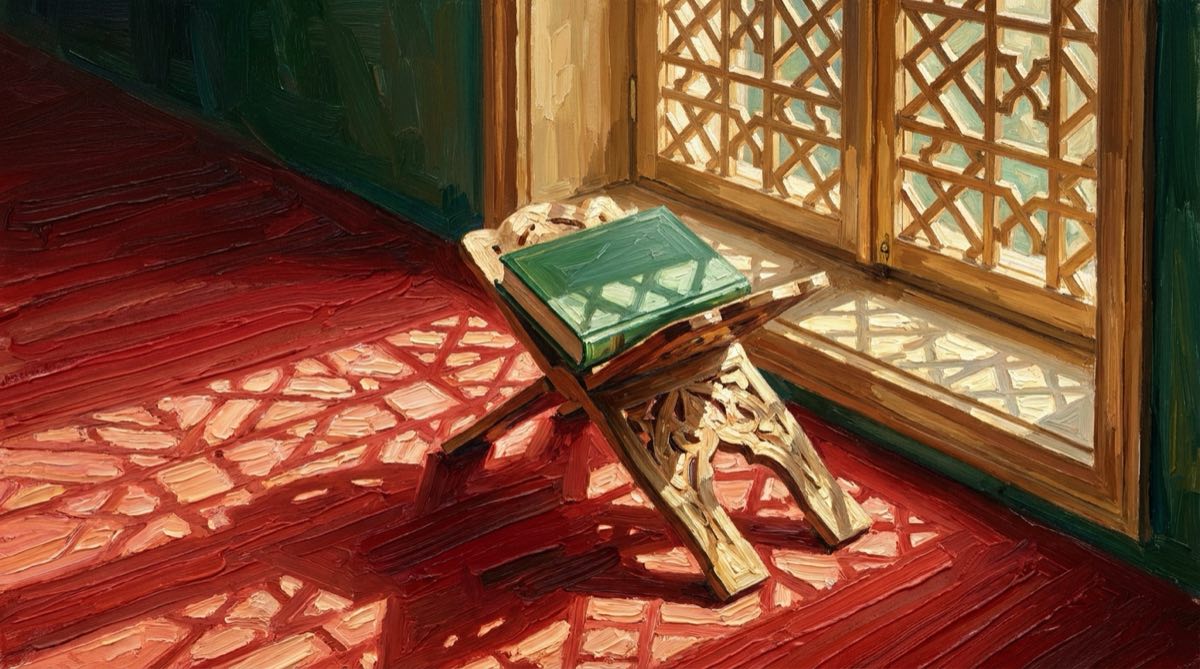

Maybe you were ten, sitting cross-legged in a mosque after school, rocking gently over a mushaf while a teacher listened. Maybe you finished Juz Amma, or Ya-Sin, or even the whole Quran, and your family cried and gave you a gift. And then the years came: school, work, a move to another city, marriage, children, a phone that never stops. Now you stand up to pray, start a surah you once knew perfectly, and after a few ayahs there is only silence, and a quiet, heavy shame.
This letter is for you.
You are not the only one
If you could see into the hearts of the people praying beside you at Jumu'ah, you would find this same silence in many of them. Forgetting what you memorized is so common that the Prophet ﷺ spoke about it directly, and the way he spoke about it is gentle:
“How bad it is for one of them to say, ‘I have forgotten such-and-such ayah.’ Rather, he was made to forget. Keep reciting the Quran, for it escapes from the hearts of men faster than camels from their ropes.”
Sahih al-Bukhari 5032, Sahih Muslim 790Notice what he did not say. He did not say: you have failed, give up, it is too late. He said: keep reciting. The cure he gave is the same as the warning: come back, and keep coming back.
Don't let shame keep you away
Shame is the trap. It whispers that since you have lost it, there is no point in opening the mushaf, that you will only be reminded of what you no longer have. So the mushaf stays closed, and the forgetting grows. Shaytan does not need you to forget the Quran; he only needs you to be too ashamed to come back to it.
قُلْ يَـٰعِبَادِىَ ٱلَّذِينَ أَسْرَفُوا۟ عَلَىٰٓ أَنفُسِهِمْ لَا تَقْنَطُوا۟ مِن رَّحْمَةِ ٱللَّهِ
“Say, O Prophet, that Allah says, ‘O My servants who have exceeded the limits against their souls! Do not lose hope in Allah's mercy…’”
Az-Zumar 39:53And remember the prayer Allah Himself taught the believers to make, at the very end of Al-Baqarah: “Our Lord! Do not punish us if we forget or make a mistake” (2:286). He taught us to ask for that because He knew we would forget.
It is still there
Here is something that should give you real hope: relearning is much faster than learning the first time. Memory researchers have known this for over a century. When you relearn something you once knew, it comes back in a fraction of the original time, even when you feel you have forgotten it completely. The paths are still there, overgrown but not erased.
You may find that you can't start a surah, but if someone recites the first ayah, the second comes to your lips by itself. That is not nothing. That is the Quran, still in you, waiting.
“The one who recites the Quran and stumbles over it, finding it difficult, will have two rewards.”
Sahih al-Bukhari 4937, Sahih Muslim 798The stumbling, the struggling, the starting again: all of it is rewarded. Twice.
How to start again, gently
A first month back
- Week 1Don't try to recover everything. Pick the three surahs you recite most in prayer. Listen to each once a day; recite along.
- Week 2Recite those three from memory each morning, then check. Fix every slip. Add one more short surah you used to know.
- Week 3Choose one longer surah you once knew (Al-Mulk, Ya-Sin, a page of Al-Baqarah). Relearn five ayahs a day. You will be surprised how fast it returns.
- Week 4Put everything you have recovered into a rotation: recite a little of it in every prayer. Now it is yours again, and this time you have a way to keep it.
- Start with what you use. Surahs you recite in prayer get revised automatically, so they are the easiest to keep once recovered.
- Listen before you recite. Hearing a familiar surah from the reciter you grew up with can bring whole passages back at once.
- Don't measure yourself against who you were at fifteen. Measure yourself against who you were last week.
- Build the revision in this time. The reason it faded was not your memory; it was the lack of a system. Our guide to memorizing and never forgetting gives you one.
A promise
The Quran does not hold grudges. The surah you neglected for ten years will not refuse to come back to you. It will return the way a friend does when you finally call after a long silence: a little awkward at first, and then as if no time had passed at all.
Open your mushaf today. Recite one surah you used to know. If it comes back, praise Allah. If it doesn't, recite it from the page, and begin again tomorrow. Either way, you have come home.
فَإِنَّ مَعَ ٱلْعُسْرِ يُسْرًا إِنَّ مَعَ ٱلْعُسْرِ يُسْرًا
“So, surely with hardship comes ease. Surely with that hardship comes more ease.”
Ash-Sharh 94:5–6
Pick the surahs you used to know, recite them from memory and let Qaree mark the words that slipped. It brings each ayah back before it fades again.
Sources
- Sahih al-Bukhari 4937, 5032; Sahih Muslim 790, 798.
- Quran 2:286, 39:53, 94:5–6; translation: Dr. Mustafa Khattab, The Clear Quran.
- On relearning being faster than first learning (“savings”): H. Ebbinghaus, Über das Gedächtnis, 1885.